
Guide
Should you pre-order vinyl? An honest guide
 By Surface Noise
Updated
17 min read
The short answer
If you know you want a record, pre-order it. Limited editions can sell out within days of pre-orders opening, and even standard black pressings can be hard to find for years before a repress. Pre-orders do have real downsides, mainly delays and copies reaching shops first, so reserving a copy at a local record shop is often the best of both. Wherever you buy, buy from the label, the artist or the shop they’ve chosen, at retail price.
Based on nearly 400 comments from vinyl fans, 2022 to 2026 · How we researched this
See what’s on pre-order, every weekend
One email a week with new pressings, reissues, pre-orders and back-in-stock alerts, and where to buy them.
Free · One email a week · Just your email address · Unsubscribe anytime
Your four options, at a glance
Why fans are going off pre-orders
We read nearly 400 comments from vinyl fans on Reddit, YouTube and music blogs, from 2022 to this month. The complaints have barely changed in four years. In order of how often they came up:
The most common view: a pre-order exists to guarantee you a copy. When it doesn’t, or the shop down the road gets it first, fans stop seeing the point.
Why most fans still pre-order
Most of what’s posted online comes from people explaining why they’ve stopped. Far more people pre-order every week and never post about it. Most haven’t given up; they’ve become selective. Here’s what the complaints leave out.
A rule many fans live by: if you see it and you want it, buy it. You may not see it again at that price.
Example
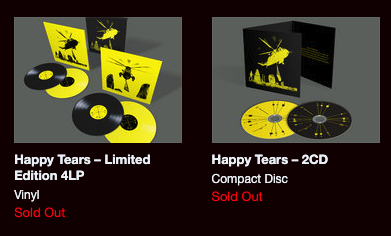
Mogwai’s Happy Tears: some editions gone within days
Mogwai announced Happy Tears, a 30th-anniversary compilation on their own label Rock Action, on 30 September 2026, with pre-orders opening the same day. By Monday 5 October, the limited edition 4LP and the 2CD had sold out on the band’s own store, more than three months before the 8 January 2027 release date.
Anyone waiting for release day, or for reviews, would have missed those editions at retail price. Some record shops still had copies, which is worth knowing too: sold out in one place doesn’t always mean gone everywhere.
- 30 SepAnnounced, pre-orders open
- 5 Oct4LP and 2CD sold out on the band’s store
- 8 Jan 2027Release date
The case for pre-ordering
For an independent label, a record is a big upfront cost: mastering, test pressings, the pressing run, sleeves and shipping, all paid before a single copy sells. Pre-orders help cover that cost and tell the label how many to make. That’s why a blanket boycott tends to hurt the small labels and artists fans most want to support. The fairer answer is to pre-order where it matters, and wait where it doesn’t.
“Indie labels have a lot of unseen expenses associated with each release.”
Waxwork Records, independent label, in A Different Perspective on Pre-Orders
Why do record shops get vinyl before pre-orders arrive?
Shops get stock from distributors in time to sell it on the official release date. Many label and artist stores pack their own orders in batches, which can mean shipping on or after release day.
Two routes from the same pressing plant
Shop stock
- Pressing plant
- Distributor
- Shop, before the release date
- On the shelf on release day
Direct pre-order
- Pressing plant
- Label or fulfilment warehouse
- Packed in batches
- Ships on or after release day
A shop ordering through a distributor is working towards a fixed release date. A label or artist store usually only has to avoid selling before that date, and may have a small team packing thousands of orders, so the last batch can leave weeks after the first. It isn’t a sign that pre-order customers don’t matter. It’s why a record can be on a shop shelf while yours is still in a warehouse.
Why do vinyl pre-orders take so long?
Making a record takes many steps, and a problem at any of them pushes the date back.
- Busy pressing plants. There are only so many presses, and small runs can wait behind much bigger jobs.
- Test pressings. The label and artist check a test copy before the full run. If it fails, the process starts again.
- Materials and packaging. Coloured vinyl, special sleeves and inserts each add steps.
- Rights and licensing. Reissues can stall if a licence isn’t agreed.
- Packing and shipping. A small team may be packing thousands of orders by hand.
You can see every one of those steps in this film from WIRED, which follows a record through the pressing plant at Third Man Records.
Want it on release day? Reserve a copy at your local record shop, or ask the store you’re buying from whether pre-orders ship to arrive on the release date.
Does a pre-order guarantee you a copy?
It’s meant to, and most do. But a pre-order can be cancelled if the seller takes more orders than it receives stock for, if a pressing fails, or if the rights to a record fall through.
Limited variants are the most exposed, because there’s no spare stock to cover a shortfall. Sellers who show how many copies are left, or cap pre-orders until their allocation is confirmed, are less likely to oversell.
What does a 2050 release date mean on a vinyl pre-order?
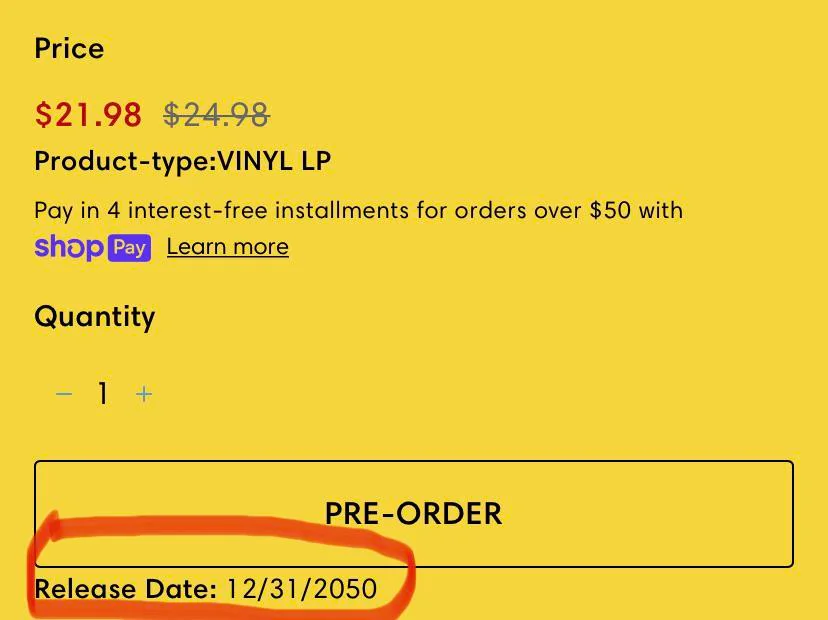
It’s a placeholder. Some retailers use a far-future date, such as 31 December 2050, when a release has no confirmed date, often because of a production or rights problem.
The date may be updated once the label confirms a new one, or the release may be cancelled. If a record you’ve pre-ordered suddenly shows a date like this, ask the seller what’s happening, and whether you can cancel for a full refund while you wait.
Should you pre-order this record? Four questions
Answer these about the record you’re looking at. They’re the rules experienced fans use, in one place.
Is it limited, numbered, signed or an exclusive?
Look for an edition size, “exclusive” or “signed” in the listing.
Do you know you want it, or trust the label?
You’ve heard it, you buy this artist regardless, or the label rarely lets you down.
Can a local record shop get it for you?
Ask whether they can reserve or order in a copy.
Would you be fine if it arrived six weeks late?
Or after it reaches shops.
Our suggestion
Answer the four questions
Your suggestion appears here.
Reserve it at your local shop
Standard editions usually last longer, but not always. Ask your shop to hold a copy for release day: no postage, and it supports the shop.
Less pressure, but not none
Standard editions usually last longer than limited ones, but some sell out and aren’t repressed for years. If you’d be upset to miss it, pre-order anyway.
Listen if you can, but don’t wait for reviews
Reviews usually arrive around release day, often after limited editions have gone. Play any early singles, look at what else the label puts out, and decide whether missing it would bother you more than owning it.
Pre-order through your local shop
You get the edition you want and you’re more likely to have it on release day. Check first that the shop’s allocation includes the variant you’re after.
Pre-order it
This is what pre-orders are for. Buy from the label, the artist or the shop they’ve chosen, and keep it in a separate order from in-stock records.
Pre-order, but choose the seller carefully
Pick a seller that shows stock numbers or ships pre-orders to arrive on release day, and check the cancellation policy before you pay.
Nearly there
Answer the last question.
Pre-order when
- It’s genuinely limited. A stated edition size, a numbered run or signed copies.
- It’s an exclusive. Sold only by one shop or the label’s own store.
- You’d buy it regardless. An artist you always buy, or a reissue of an album you already love.
- A small artist needs it. Some pressings only go ahead once enough pre-orders are in.
- Your shop won’t stock it. For small labels and self-releasing bands, a pre-order may be the only way.
- There may not be another chance. Represses aren’t guaranteed, and some arrive five or ten years later.
Wait when
- It’s widely stocked. If several shops carry it and the label represses it regularly, there’s little risk in waiting.
- It’s a big-label standard pressing. These are usually made in large numbers.
- You care most about pressing quality. Buyers report on pressings after release; limited editions may be gone by then.
- You can reserve it locally. A shop hold gets you the record on release day without paying months in advance.
- You’re buying because of a countdown. Urgency in a sales email isn’t the same as a record selling out.
Know which records are limited before you decide
Every Surface Noise entry spells out the format and edition size, with a link to where the artist or label is selling it.
One email a week with new pressings, reissues, pre-orders and back-in-stock alerts, and where to buy them.
Free · One email a week · Just your email address · Unsubscribe anytime
Where to pre-order: label, artist, local shop or big retailer?
Label and artist stores send the most money to the people who made the record, and often have exclusive variants. A local record shop is usually the most reliable way to have it on release day.
General patterns, not rules
| What you care about | Label store | Artist store or Bandcamp | Local record shop | Online record shop | Big online retailer |
|---|---|---|---|---|---|
| Money reaches the artist and label | Most direct | Most direct | Yes, and supports the shop | Yes, and supports the shop | Usually the smallest share |
| In your hands on release day | Varies | Varies | Often, if you collect | Varies | Varies |
| Exclusive variants | Often | Often | Sometimes | Sometimes | Sometimes |
| Clear stock information | Varies | Varies | Ask in person | Some show exact stock | Rarely |
| No postage or shipping damage | No | No | Yes, if you collect | No | No |
How to pre-order through your local record shop
Ask in the shop, or by email, whether they can reserve a copy for release day. Many will order in records they don’t usually stock, hold them for a few days, and let you know when they arrive. You pay the shop’s price, there’s no postage and no risk of shipping damage, and you’re supporting a shop you’d like to keep.
Buy it at a gig
If a band is touring around a new album, they’ll usually bring vinyl to the merch stand, sometimes including tour-only variants. They carry the most copies at the start of a tour, so early dates are your best chance, and the money goes straight to the band.

Buying vinyl from abroad: shipping, customs and region limits
Ordering vinyl from another country has become slower and more expensive, and some sellers have stopped shipping to certain regions altogether.
It’s easier than ever to discover a band on the other side of the world, and harder to get their records. A small band may have no label or distributor in your country, so importing is the only option, with postage, customs charges and long delivery times on top.
Since Brexit, sending records between the UK and the EU has meant extra paperwork and charges. Since 1 July 2026, parcels worth up to €150 sent into the EU from outside it, including from the UK and the US, have carried a new flat €3 customs duty per item type, on top of VAT. Stricter product information rules for those parcels are enforced from 1 November 2026. The US has also tightened duties on imported parcels.
On the pre-order page for the 2026 grey vinyl reissue of Come On Die Young, Mogwai’s store explains it can’t currently ship to the EU or North America because of “unpredictable and prohibitively high shipping and customs costs”, and suggests finding a copy at a local record store instead.
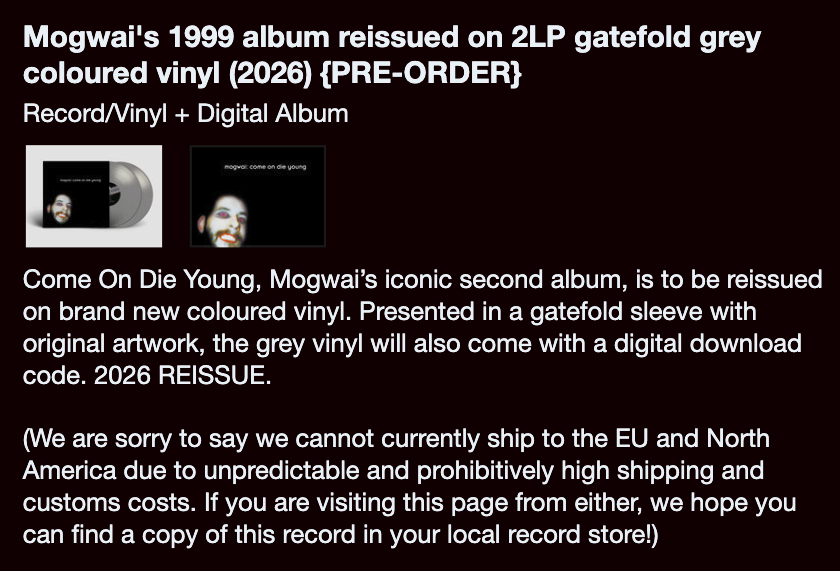
This is part of why pre-ordering can feel broken. A delay or cancellation that looks like the seller’s fault is sometimes a customs or shipping problem neither the band nor the shop can control.
Buying from abroad? Check whether the seller ships to you before pre-orders open, look for a stockist in your own country, ask your local shop whether they can order it in, and add postage and import charges to the price before you decide.
Surface Noise links to the shops artists and labels have chosen, mostly in the UK and US, so you can see where a record is sold before you work out the postage.
Before you pre-order: a checklist
| Check | Why |
|---|---|
| Is the edition size stated? | “Limited” without a number tells you very little. |
| Is this the variant you want? | Other shops may have their own exclusive colours. |
| When does it really ship? | Look for “ships on release day” or a dispatch date. |
| What’s the cancellation policy? | Some sellers charge a fee to cancel a pre-order. |
| Are you mixing it with in-stock records? | Many stores ship the whole order when the last item is ready. Order separately. |
| How much is postage? | Pre-orders are rarely combined, so you may pay postage on each one. |
| Could a shop hold it for you? | It may be quicker and cheaper. |
| Have you kept the confirmation email? | You’ll need it if you have to ask for a refund. |
My pre-order is late or cancelled. What should I do?
- Check the seller’s updates first. Look at the product page, your emails and the label’s social posts for a new date.
- Ask for a new date in writing. A specific date is more useful than “ships soon”.
- Decide whether to wait or cancel. If the record is already in shops, you may be able to cancel and buy a copy locally.
- If it’s cancelled, ask for a refund to your original payment method. Keep the cancellation email. If the refund doesn’t arrive, your card provider or payment service may be able to help.
- Check other shops before you pay resale prices. Popular records often come back in stock or get repressed.
473%
Average reseller markup on shoegaze vinyl
Before you replace a cancelled pre-order with a resale copy: our Vinyl Report found resellers charge nearly six times retail price on average.
Pre-order myths, checked
| Myth | Verdict | What’s actually true |
|---|---|---|
| “First pressings sound worse” | MYTH | Quality varies from pressing to pressing, not by whether it’s the first. |
| “Pre-orders arrive before release day” | NOT RELIABLY | Some do. Today many direct stores ship on or after release day. |
| “A pre-order guarantees a copy” | USUALLY | Most are fulfilled, but overselling and cancellations do happen, mainly with limited variants. |
| “Pre-ordering saves money” | RARELY | Pre-orders are normally full retail price. The benefit is securing a copy, not a discount. |
| “I’ll wait for the reviews” | OFTEN TOO LATE | Reviews usually appear around release day, after limited editions are often gone. |
| “Black vinyl never sells out” | NOT TRUE | Standard pressings on small labels sell out too, and represses can take years. |
| “It’ll be repressed soon” | NOT GUARANTEED | Some records come back within months. Others take five or ten years, or never return. |
| “Boycotting pre-orders will fix things” | IT CAN BACKFIRE | Labels use pre-orders to decide how many copies to press. Small labels and artists are hit hardest when pre-orders fall. |
Ours
How Surface Noise helps you decide
We don’t tell you to pre-order. We tell you what’s been announced, what kind of edition it is and where to buy it, so you can decide using the rules above. Every record is chosen and checked by hand before it reaches your inbox.
- Pre-orders are included once you can order. We wait until a record can be pre-ordered, then it’ll be in the weekly email.
- The exact edition is spelled out. Format, colour and edition size, in the source’s own words when they’re stated.
- Back-in-stock alerts are part of the weekly email, so a sold-out pre-order isn’t always the end.
- Every record links to where the artist or label is selling it, at retail price.
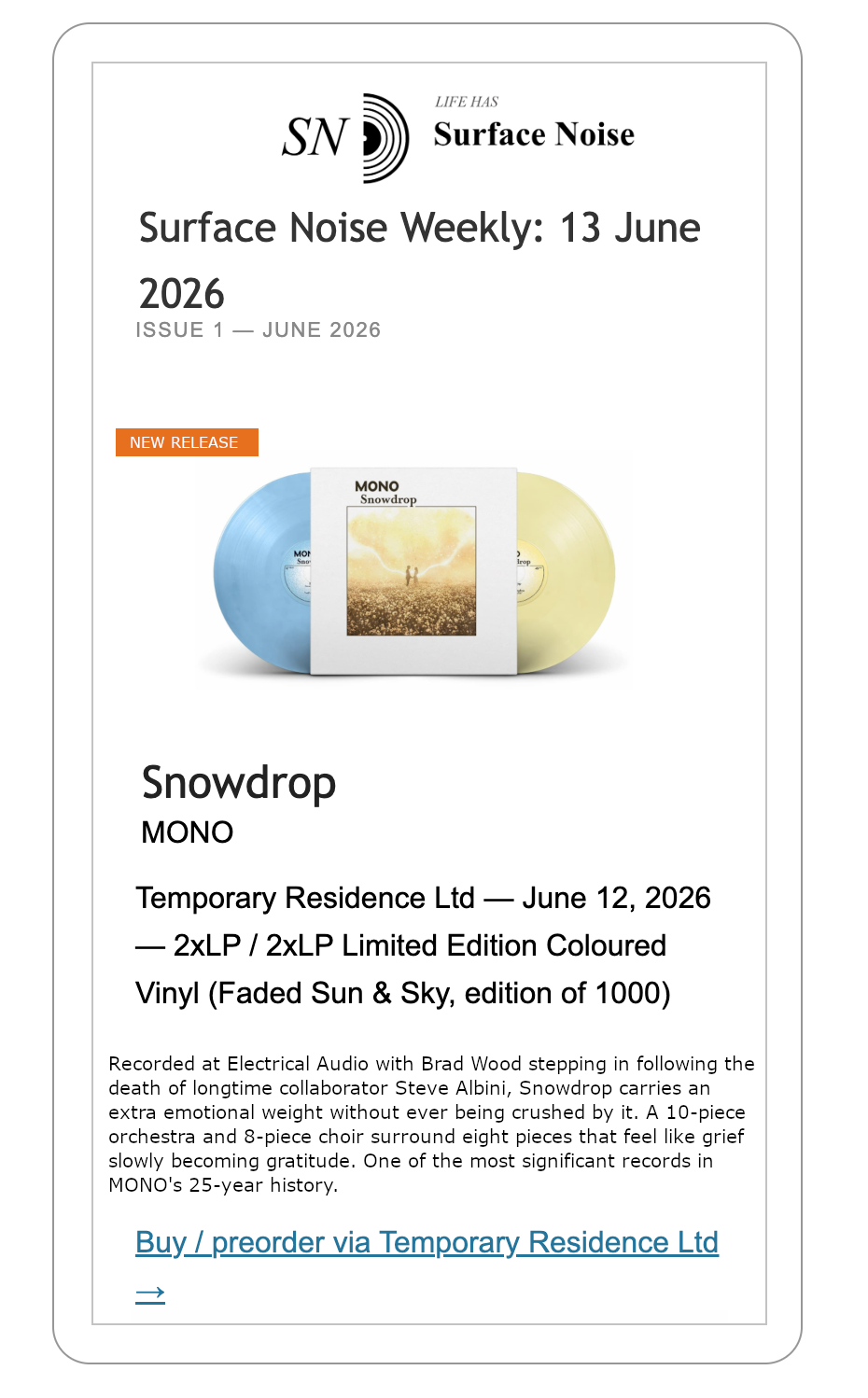
Get the weekly email
One email a week with new pressings, reissues, pre-orders and back-in-stock alerts, and where to buy them.
Free · One email a week · Just your email address · Unsubscribe anytime
How we researched this guide
We read nearly 400 comments across three r/vinyl threads, the comments on a YouTube video, an essay in Copper magazine and a record shop’s guide to pre-orders, all published between 2022 and October 2026. We grouped the complaints and rules by how often they came up, and paraphrased rather than quoting anyone. Stories about individual sellers are single experiences, so we haven’t named any.
Most of what’s posted online comes from people explaining why they’ve stopped pre-ordering, so complaints are over-represented. We’ve balanced them with what we see at Surface Noise: readers who want to hear about records before the chance to buy them has gone.
Frequently asked questions
Are vinyl pre-orders worth it?
If you know you want the record, usually yes. Limited editions can sell out within days, and even standard pressings can be hard to find for years before a repress. The downside is waiting, and sometimes seeing copies in shops first. Reserving a copy at a local record shop avoids most of that.
Do vinyl pre-orders guarantee a copy?
They're meant to, and most do. But a pre-order can be cancelled if the seller takes more orders than it receives stock for, if a pressing fails, or if the rights to a record fall through.
Why do record shops get vinyl before pre-orders arrive?
Shops get stock from distributors in time to sell it on the official release date. Many label and artist stores pack their own orders in batches, which can mean shipping on or after release day.
Why do vinyl pre-orders take so long?
Pressing plants are busy, test pressings need approving, and a problem at any stage, from materials to licensing, pushes the date back. Small runs can also wait behind larger jobs.
What does a 2050 release date mean on a vinyl pre-order?
It's a placeholder. Some retailers use a far-future date such as 31 December 2050 when a release has no confirmed date, often because of a production or rights problem. The date may be updated, or the release cancelled.
Is it cheaper to pre-order vinyl?
Usually not. Pre-orders are normally sold at full retail price. The benefit is securing a copy, not a discount.
Should I pre-order from the label, the artist or a record shop?
Label and artist stores send the most money to the people who made the record and often have exclusive variants. A local record shop is usually the most reliable way to have it on release day. All of them sell at retail price.
Should I mix pre-orders and in-stock records in one order?
It's best not to. Many stores ship an order only when every item is ready, so one delayed pre-order can hold up the rest.
What should I do if my vinyl pre-order is cancelled?
Ask for a refund to your original payment method and keep the cancellation email. If the refund doesn't arrive, your card provider or payment service may be able to help. Then check other shops before paying resale prices: popular records often come back in stock or get repressed.
How do I know if a vinyl record will sell out?
Stated edition sizes, shop or label exclusives and signed copies are the most likely to go quickly. Records on small labels can sell out in days, even on standard black vinyl.
Will a sold-out vinyl record be repressed?
Sometimes, but there's no guarantee. Some records come back within months; others take five or ten years, or never return. Surface Noise's weekly email includes back-in-stock alerts and represses.
How can I hear about vinyl pre-orders before they sell out?
Surface Noise is a free weekly email with new pressings, reissues, pre-orders and back-in-stock alerts, and where to buy them. Each entry spells out the format and edition size, with a link to where the artist or label is selling it.
Pre-order when it matters. We’ll show you what’s coming.
One email a week with new pressings, reissues, pre-orders and back-in-stock alerts, and where to buy them.
Free · One email a week · Just your email address · Unsubscribe anytime
Keep reading