
Guide
How Surface Noise chooses the vinyl records in every issue
 By Surface Noise
Updated
13 min read
The short answer
Surface Noise gathers vinyl announcements from labels, artists and record shops across the UK, Europe and the US, and every record has to pass six checks before it reaches you. It must be confirmed on vinyl by the source. It must sit in the scenes we cover. It must be available to buy right now, as a preorder, a new release or a genuine restock. You must be able to buy it direct at the original retail price. It must be new to you, not repeated from a recent issue. And our featured picks are spread across labels and shops so no one source dominates the top of your email. Then every issue is checked before it’s sent.
That’s the difference between a feed and a filter. A feed shows you everything and leaves the sorting to you. Surface Noise does the sorting first, so the one email you read each week is worth reading, and everything in it is something you can act on. Here’s exactly how it works.
| A feed | Surface Noise |
|---|---|
| Shows you everything | Does the sorting first |
| You sort it | Six checks per record |
| Check it constantly | One email a week |
New here? Start with How to never miss a vinyl release: every method, compared honestly.
How Surface Noise chooses its records
01 Sourcing
We gather vinyl announcements from labels, artists and record shops across the UK, Europe and the US.
02 Curation
Every record has to pass each check. If it fails one, it’s left out.
03 Send alert
Each issue is checked, then sent to you once a week.
Where the records come from
Every release starts with an announcement from the people selling it first, and we cast a wide net to catch them. Surface Noise draws on:
Some of the sources we read
United States
Labels · Sub Pop, Temporary Residence, Slumberland, Sacred Bones, Captured Tracks, Numero Group, Kranky
Shops · Amoeba Music
UK and Europe
Labels · Rough Trade, XL Recordings, Bella Union, Sonic Cathedral
Shops · Norman Records, Piccadilly Records, Resident Music, Banquet Records
In the US, that includes labels such as Sub Pop, Temporary Residence, Slumberland, Sacred Bones, Captured Tracks, Numero Group and Kranky, and shops such as Amoeba Music. In the UK and Europe, it includes labels such as Rough Trade, XL Recordings, Bella Union and Sonic Cathedral, and shops such as Norman Records, Piccadilly Records, Resident Music and Banquet Records. Those are a handful of names from a much longer list.
It’s the same following, checking and sign-ups a dedicated collector would have to do by hand, across dozens of accounts and inboxes. We do all of it every week and put the results in one place.
Building on first-hand announcements matters because it’s where the details are right. The label knows exactly which colourway is limited to 500 copies, which shop has the exclusive, and when preorders close. Second-hand sources blur those details, and the details are what decide whether you get the record.
What we never use as a source
Rumours or speculation. If a label hasn’t announced it, it isn’t in the newsletter.
Resale listings. Discogs sellers, eBay and marked-up marketplace listings are never where a Surface Noise recommendation comes from, and never where it sends you.
Paid placement dressed up as editorial. A record is in the newsletter because it passed the rules, not because someone paid for the spot.
Know a label or shop we should be reading? Reply to any issue, or find us on X and Instagram. We’ll take a look.
The six rules every record has to pass
It’s confirmed on vinyl by the source
A release only goes in if the label, artist or shop explicitly says it’s available on vinyl: LP, 2xLP, 7″, 12″, a named colourway. If the announcement only mentions CD, cassette or digital, it’s out. If the wording is unclear, it’s out too. We don’t guess.
Why it matters to you: when an entry says “2xLP, limited coloured vinyl, edition of 1,000”, that’s what you’ll get.
It sits in the scenes we cover
Surface Noise covers shoegaze, post-rock, dreampop, ambient and experimental music, noise rock, post-punk, art-punk, indie rock, slowcore and math rock. We also include the artists fans of those scenes love, even when the records are decades old: think David Bowie, Talk Talk, Kate Bush, Scott Walker, Brian Eno, Nico, Can, Neu! and Suicide.
In
- Shoegaze
- Post-rock
- Dreampop
- Ambient
- Experimental
- Noise rock
- Post-punk
- Art-punk
- Indie rock
- Slowcore
- Math rock
Out
- Classic rock
- Mainstream pop
- Country
- Heritage acts with no link to the scene
What we leave out is just as deliberate: classic rock, mainstream pop, country, and heritage acts with no real link to the scene. If a record wouldn’t be reviewed by the likes of The Wire or Pitchfork, or turn up in an independent shop’s staff picks, it isn’t for this newsletter. The rare exception is a genuinely important or highly collectible pressing that our readers would want to know about, even if it sits just outside these scenes.
Why it matters to you: you don’t have to follow artists one by one. If a band you love is part of these scenes, you’ll hear about them, along with the adjacent bands you’d love too.
You can buy it right now
We only include a record once you can actually order it: when preorders have opened, when it’s just been released, or when it’s genuinely back in stock. If we hear that a record is being made but there’s no release date and nowhere to preorder, we hold it back until there is. Every entry is something you can act on the moment you read it.
We also focus on what’s new. A record that has been on shop shelves for months isn’t news, so it isn’t covered. The exception is a record that had sold out or gone out of print and has come back: when a shop tells us it has fresh copies, we’ll tell you too, including how long it’s been unavailable, so you know how rare the chance is.
Why it matters to you: Surface Noise isn’t reading material about records you can’t get. It’s your chance to secure the record while it’s available, at the right price.
You can buy it direct, at the original retail price
Every entry links to wherever the artist or label is selling the record: the label’s own store, the artist’s store, or the record shop carrying it. Every link reads “Buy from” followed by the seller’s name, so you always know where you’re going. If there’s no direct place to buy a record, it doesn’t go in. And nothing is ever mentioned in an issue’s introduction unless it has a full entry and a buy link below.
Why it matters to you: you pay the price the label or shop set, and the money goes to the people who made the record.
473%Average reseller markup · shoegaze vinyl
Our vinyl price report, built from more than 5,000 real sales, found resellers mark up shoegaze records by an average of 473%.
It’s new to you
Before a record makes the cut, it’s checked against the previous four issues. If it’s appeared in any of them, it’s left out, even if it’s moved from preorder to shipping. The only exception is a genuine surprise restock of something that had sold out, which gets a single line rather than a feature.
Why it matters to you: every issue is worth opening, because nothing in it is a rerun.
The featured picks are spread across labels and shops
Every issue has two parts. At the top is a featured selection: the six to twelve records we think you most need to see that week, each with artwork, the full details and a short note on why it matters. Below that is everything else that’s relevant this week, each with its label, format and a direct link to buy.
The balance rule applies to the featured selection only. Some weeks one label or shop has a run of great releases, but no single source takes more than two of the featured spots, and two picks from the same source never sit side by side. Nothing is dropped because of this. If a label announces eight great records in one week, you’ll see all eight: the strongest in the featured section, and the rest in the full list below.
Why it matters to you: the top of your email is a genuinely curated view of the whole scene, not one shop’s catalogue, and the full list means you never miss a relevant record.
Checked before it’s sent
Every issue starts life as a draft. Before it’s published on the site or emailed to you, it’s read through and checked: the formats, the links, the dates and the balance of the week. Only then does it go out.
What every entry tells you
Each featured record in the newsletter follows the same layout, so you can scan an issue in a couple of minutes and know exactly what you’re looking at:
- What kind of release it is: new release, reissue, first time on vinyl, preorder, or back in stock.
- The album and the artist.
- The label and the release date.
- The exact format: number of discs, colourway and edition size, in the source’s own words.
- A short note on why it matters: who it’s for and what makes this pressing worth knowing about.
- Where to buy it direct: “Buy from” followed by the label or shop’s name.
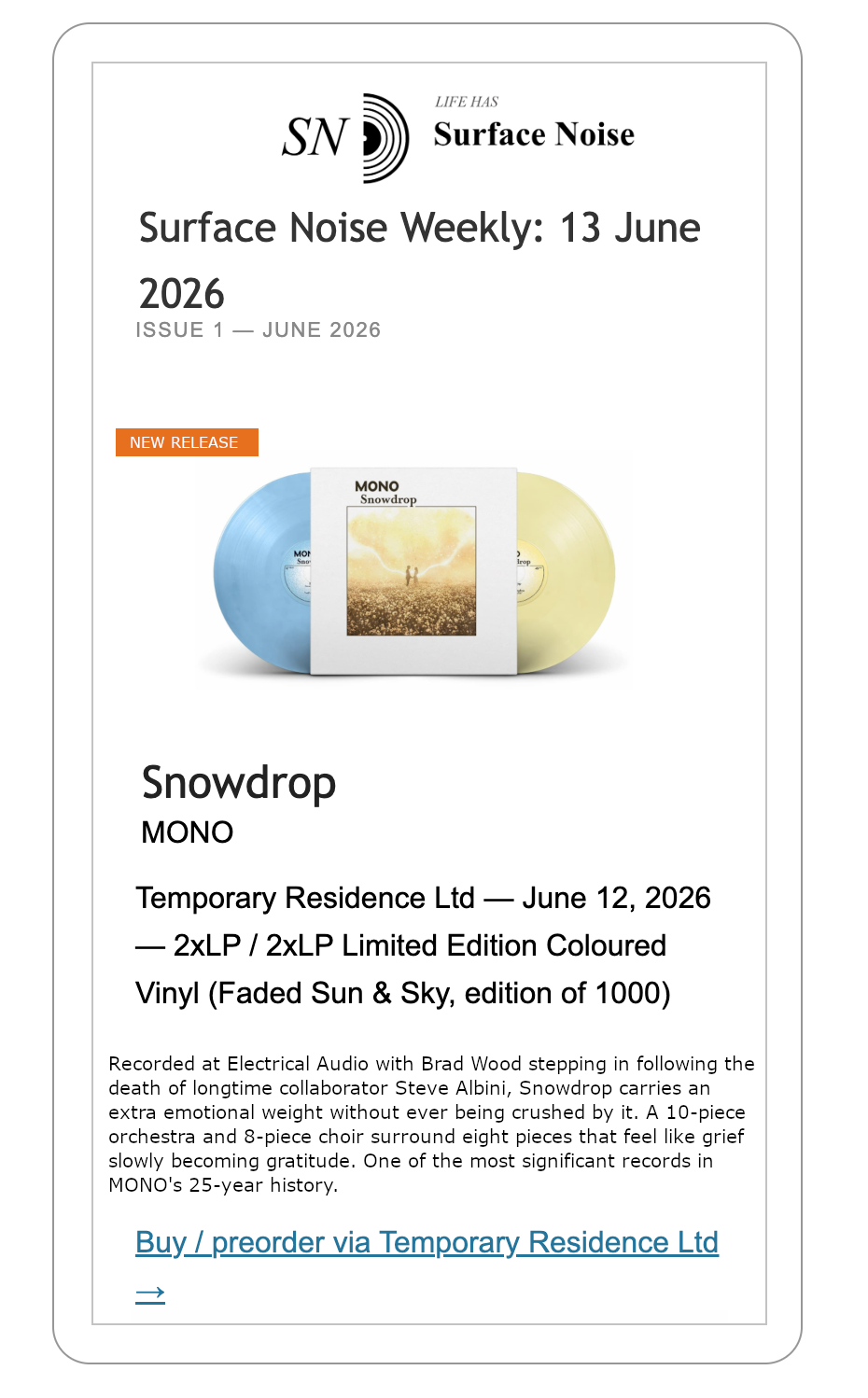
Below the featured records, every issue lists everything else that’s relevant that week, each with its label, format and a direct buy link. Nothing is mentioned without a way to buy it.
See the six rules in action every week
New releases, reissues, limited editions and restocks, each confirmed on vinyl and linked direct at retail price.
Weekly, free, independent.
What we deliberately don’t do
A good filter is defined as much by what it leaves out. Each of these is a choice, made so the newsletter stays useful:
We don’t sell records. We have no stock to shift and no reason to push one record over another. Every link goes to wherever the artist or label is selling the record.
We don’t cover every genre. A newsletter that covers everything turns back into the feed you were trying to escape. Staying within a set of connected scenes is what makes discovery work: the bands next to the ones you love are the ones you’re most likely to love next.
We don’t make you build a list. No app, no account, no artists to add. Your email address is the whole setup.
We don’t send alerts all week. One email, once a week, arriving while records are still in their preorder window. Your inbox stays calm, and nothing needs checking in between.
We don’t point you to the resale market. New records are covered while you can still buy them at retail price, before resellers get involved.
Why buying direct matters
When a limited pressing sells out, the next place it usually appears is a resale listing, at a price set by someone who had nothing to do with making the record. That money never reaches the artist, the label or the shop.
Surface Noise exists to break that pattern. Hear about the record early, buy it direct, and pay what it’s actually meant to cost.
Frequently asked questions
Is Surface Noise reliable?
Every record comes from a label, artist or shop announcement, is confirmed on vinyl in the source's own words, and links direct to where you can buy it at retail price. Each issue is checked before it's sent. If the format or the buy link can't be confirmed, the record is left out.
How does Surface Noise choose which records to include?
Every record must pass six rules: confirmed on vinyl by the source, part of the scenes we cover, available to buy right now, available direct at the original retail price, not already covered in the previous four issues, and, for the featured picks, part of a balanced spread across labels and shops.
Where do Surface Noise's listings come from?
From labels, artists and record shops in the UK, Europe and the US: their mailing lists, updates that shops send us directly, announcements sent to our submissions address, and the social channels of smaller bands that don't have a mailing list. Sources include US labels such as Sub Pop, Temporary Residence, Slumberland, Sacred Bones, Captured Tracks, Numero Group and Kranky, UK labels such as Rough Trade and XL Recordings, and UK shops such as Norman Records and Piccadilly Records. Never rumours or resale listings.
Will I see every relevant release, or only a few?
Every relevant release. Each issue opens with a featured selection of six to twelve records, spread across labels and shops, and then lists everything else in our scenes that you can buy that week, each with a direct link.
Do you share every record from a label or record shop?
No. Most labels and shops release or sell all kinds of music, from indie and post-rock to metal, pop and hip-hop. We only include the records that matter to Surface Noise readers: releases in the scenes we cover, and records by artists that fans of those scenes love. Everything else is left out, so your inbox isn't filled with records you'd never buy.
Now and then, a record outside those scenes is too important to leave out: a rare or highly collectible pressing, such as a landmark album's anniversary box set, that our readers would genuinely want to know about. When that happens, we include it.
Do you cover records before preorders open?
No. We wait until you can actually order a record, whether that's a preorder, a new release or a restock, so everything in the newsletter is something you can act on straight away.
Which genres does Surface Noise cover?
Shoegaze, post-rock, dreampop, ambient and experimental music, noise rock, post-punk, art-punk, indie rock, slowcore and math rock, plus the artists fans of those scenes love, such as David Bowie, Kate Bush, Talk Talk and Brian Eno.
Do I need to follow artists to hear about their records?
No. If an artist is part of the scenes we cover, their vinyl releases are included automatically, along with records by the adjacent bands you'd likely love too.
Does Surface Noise sell records?
No. Surface Noise doesn't sell anything. Every record links to wherever the artist or label is selling it, whether that's their own store or a record shop, at the original retail price, and never to resellers.
Can I suggest a label, shop or release?
Yes. Reply to any issue, or message Surface Noise on X or Instagram.
One email a week, already sorted
Every record confirmed on vinyl, in our scenes, on sale now and linked direct at retail price.
Weekly, free, independent.
Keep reading